Glyphosate is a widely used weedkiller that has been linked to multiple health issues, including non-Hodgkin’s lymphoma.
Pesticides in the United States are regulated under a combination of federal, state, and local laws. Debates over state and local authority to regulate pesticide use have been litigated for decades, particularly in cases involving widely used chemicals such as Roundup and paraquat, which have been linked to serious health harms. Many states, cities, and counties have adopted measures to restrict pesticide spraying near schools, homes, and public spaces, citing the heightened vulnerability of children to toxic exposure and risks to brain development, reproduction, and long-term health.
Seven states—Maine, Alaska, Hawaii, Maryland, Utah, Nevada, and Vermont—do not preempt local governments from regulating pesticide use within their jurisdictions. In Maine alone, there are more than 30 state and local regulations related to pesticide use and warning requirements.
Rep. Anna Paulina Luna (R-Fla.) and I recently celebrated a win for the “Make America Healthy Again” movement after we successfully stripped dangerous, industry-written language from the Farm Bill that would pre-empt state rights to regulate pesticide usage or labeling and provide a liability shield for pesticide manufacturers. We also introduced the Paraquat Prevention Act, legislation that would cancel all registered uses of the pesticide paraquat under the Federal Insecticide, Fungicide, and Rodenticide Act (FIFRA) and permanently prohibit its reregistration.
Earlier this year, President Trump signed an Executive Order to increase domestic production of glyphosate. Rep. Thomas Massie (R-Ky.) and I introduced the No Immunity for Glyphosate Act, which would undo Trump’s Executive Order.
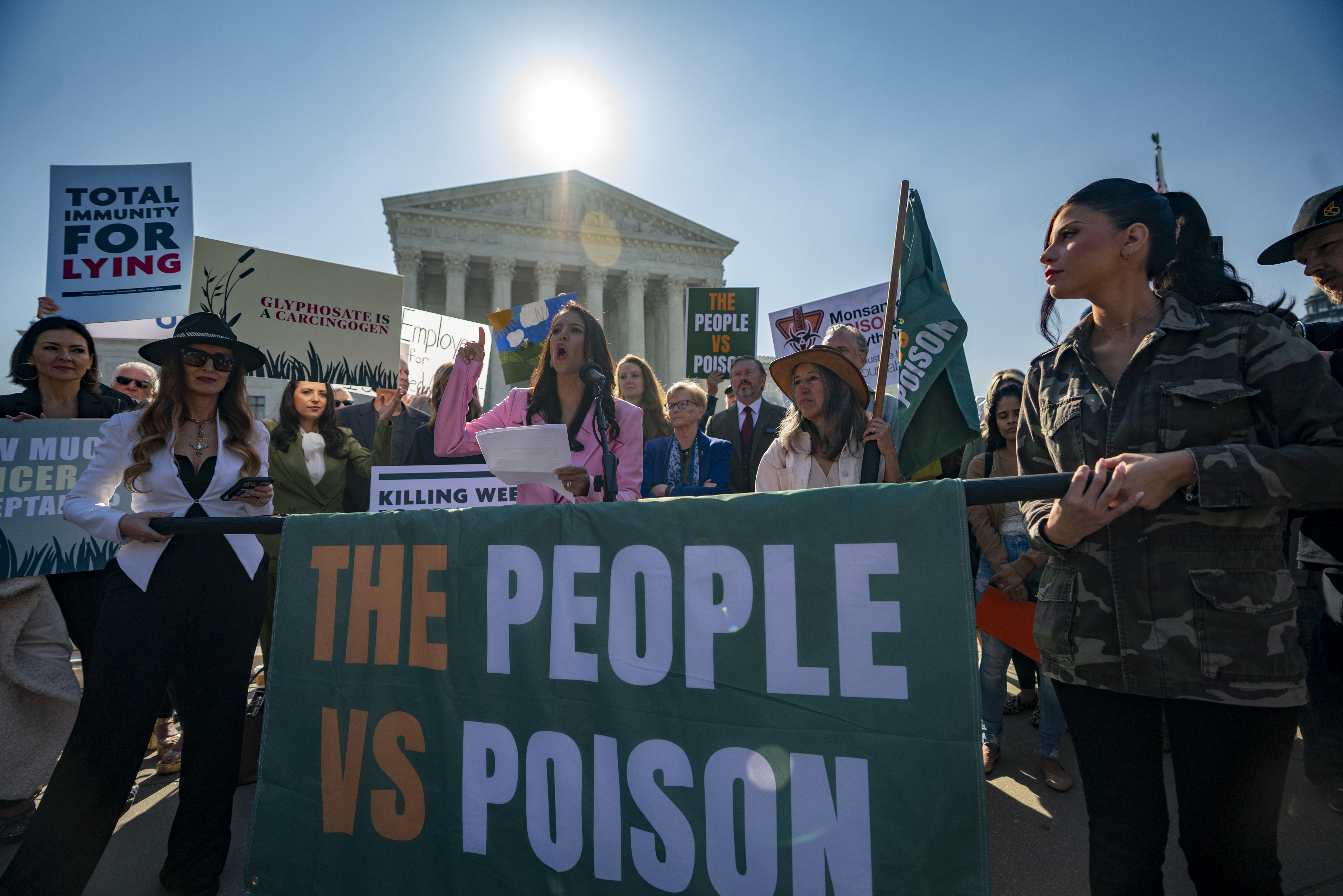
In June of 2026, the U.S. Supreme Court ruled that Monsanto cannot be held liable under state laws for failing to warn consumers about the alleged cancer risks of its weedkiller Roundup on its label. The case taken up by the Supreme Court was supported by the Trump Administration. In April, I joined the "People Vs. Poison" rally outside the Supreme Court to protest the case.
PFAS
Per- and polyfluoroalkyl substances (PFAS) are dangerous man-made “forever chemicals” that pose serious risks to every Mainer, appearing at our former military installations, farms, and water systems. This is an urgent public health and environmental threat, and it’s growing at an alarming rate—in Maine, there have been more than 30,000 records of PFAS at close to 250 sites across the state, including the former Brunswick Naval Air Station, the former Loring Air Force Base in Aroostook County, and the Kennebunkport, Kennebunk, and Wells Water District.
PFAS chemicals are persistent, bioaccumulative, and toxic. These chemicals have been linked to harmful human health effects, including cancer, reproductive and developmental harms, and weakened immune systems.
My Work to Clean Up Forever Chemicals
On the Congressional PFAS Task Force, I work with my Democratic and Republican colleagues in the House to more urgently address the public health threat of PFAS to better protect communities from the harmful effects of these dangerous chemicals.
As Ranking Member of the House Appropriations Interior, Environment, and Related Agencies Subcommittee, I oversee the Environmental Protection Agency (EPA) and work to secure funding for EPA to develop regulatory standards for drinking water and site cleanups as well as conduct additional research to understand the health effects of PFAS.
As a member of the House Appropriations Agriculture, Rural Development, and Related Agencies Subcommittee and the House Agriculture Committee, I have worked to secure additional U.S. Department of Agriculture support for dairy farmers whose livelihoods have been jeopardized by PFAS contamination.
In July 2021, I cosponsored the No PFAS in Cosmetics Act, which would require the Department of Health and Human Services to issue and finalize a rule to ban the use of intentionally added perfluoroalkyl or polyfluoroalkyl substances in cosmetics.
In November 2021, I was proud to vote for the Infrastructure Investment and Jobs Act, which invests $55 billion in water infrastructure, including $10 billion in dedicated funding to clean up dangerous PFAS.
In December 2021, Congress passed the National Defense Authorization Act for FY2022 which creates a Department of Defense PFAS Task Force, provides an additional $500 million for clean-up of military communities impacted by PFAS contamination, and requires DoD to publish to the public results of drinking and ground water testing for PFAS conducted on or near military installations, formerly used defense sites, and national guard sites.
In March 2022, Senators Susan Collins and Angus King, Congressman Jared Golden and I urged U.S. Department of Agriculture (USDA) Secretary Tom Vilsack to swiftly and fully utilize all USDA resources and authorities that can assist in responding to PFAS contamination, which is increasingly impacting Maine famers and rural communities.
In June 2022, I introduced the bipartisan Healthy Drinking Water Affordability Act, or The Healthy H2O Act, to provide grants for water testing and treatment technology directly to individuals, non-profits, and local governments in rural communities. Water quality improvement systems installed at the faucet or within a building can provide immediate and ongoing protections from known and emerging water contaminants, like PFAS, lead, and nitrates.
In the Appropriations package for Fiscal Year 2023, I helped secured $5 million to assist farmers whose land has been contaminated by PFAS for testing soil, water, or agricultural products, and to mitigate the impacts of producers impacted by PFAS contamination.
I also authored provisions in the spending bill to increase the EPA’s ability to address PFAS mitigation nationwide, increasing funding for the EPA from $5 million to $8 million to advance research on PFAS impacts in the agriculture sector. Specifically, the funds will support research to better understand PFAS uptake into plants and animals, helping reduce PFAS exposure in our food supply and promoting farm viability.
In March 2023, Rep. David Rouser (R-N.C.) and I reintroduced the Healthy Drinking Water Affordability Act, or the Healthy H2O Act, to provide grants for water testing and treatment technology directly to individuals and nonprofits in rural communities.
My fellow members of Congress from Maine and I introduced the bipartisan, bicameral Relief for Famers Hit with PFAS Act, which would authorize grants for states to provide financial assistance to affected farmers, expand monitoring and testing, remediate PFAS, or even help farmers relocate.
PFAS Work in Maine
In 2019, Governor Mills signed an executive order establishing a task force charged with studying the effects of PFAS prevalence in Maine. In January 2020, the Maine PFAS Task Force released its final report and recommendations, Managing PFAS in Maine, Final Report from the Maine PFAS Task Force. This Report influenced Maine’s 130th Legislature to establish new legislative initiatives related to PFAS. Below are some of the new PFAS laws currently undergoing implementation:
Maine’s interim drinking water standard for PFAS: Resolve, To Protect Consumers of Public Drinking Water by Establishing Maximum Contaminant Levels for Certain Substances and Contaminants
PFAS soil and groundwater evaluation: An Act To Investigate Perfluoroalkyl and Polyfluoroalkyl Substance Contamination of Land and Groundwater
PFAS sludge and sludge products ban: An Act To Prevent the Further Contamination of the Soils and Waters of the State with So-called Forever Chemicals
Statute of limitations for injuries or harm from PFAS: An Act Regarding the Statute of Limitations for Injuries or Harm Resulting from Perfluoroalkyl and Polyfluoroalkyl Substances
Revision of definition of uncontrolled substances to allow for PFAS: An Act Regarding Uncontrolled Hazardous Substance Sites
Study PFAS management at state-owned landfills: Resolve, To Address Perfluoroalkyl and Polyfluoroalkyl Substances Pollution at State-owned Solid Waste Landfills
Restrictions in firefighting or fire suppressing foam: An Act To Restrict the Use of Perfluoroalkyl and Polyfluoroalkyl Substances in Firefighting Foam
PFAS in Food Packaging: An Act To Protect the Environment and Public Health by Further Reducing Toxic Chemicals in Packaging
Regulation of PFAS in products: An Act To Stop Perfluoroalkyl and Polyfluoroalkyl Substances Pollution
April 2022, Governor Mills also signed a supplemental budget that includes $60 million dollars to set up a fund for impacted farmers. The resources include income replacement, buyback funds, medical monitoring funds (for both farmers and impacted well owners), and funding for research on cropping alternatives and an additional $9.2 million dollars to increase testing capacity and provide more staff to the Department of Agriculture, Conservation, and Forestry.